Showing posts with label The Second Vatican Council. Show all posts

Sunday, August 14, 2011

The Jewish heart of Christian prayer, Sermon of August 14th


The Jewish heart of the Mass

20th Sunday in Ordinary Time, Year A
August 14th, 2011
Romans 11:13-15,29-32

For if their [i.e. the Jews’] rejection is the reconciliation of the world, what will their acceptance be but life from the dead? For the gifts and the call of God are irrevocable.

The three readings of today’s Mass bring to the fore this relationship between the Jews and the Gentiles. In the first reading from Isaiah, the Lord tells us my house will be a house of prayer for all peoples. He asserts that all nations and all peoples (that is, the Gentiles) will be incorporated into the covenant which God has formed with the Jews. Again, in the Gospel, our Savior heals the daughter of the Canaanite woman – and we have to recall that the Canaanites were not Jews, but were pagan Gentiles. Here the good Jesus first says that he was sent only to the lost sheep of the house of Israel, but then he grants the prayer of this Gentile woman. The Lord is helping us to learn that the Gentiles will be united to the Jews and become one chosen people with them.

The Letter of St. Paul to the Romans is certainly one of the most theologically complex portions of the Scriptures, and this is seen especially in his discussion of the relation between the Jews and the Gentiles. The Apostle tells us that the Gentiles will not be saved without the Jews – that the Jewish people have, for a time, stumbled; but that they will not fall and be left behind. No, rather, the Jews (as a people) will turn again to the Lord, and this will bring about the final redemption of the whole world.
In a very real sense, Gentile Christians are “spiritual Semites” or “spiritual Hebrews”, as Pope Pius XI stated. We are “spiritual Semites” in the sense that we have been incorporated into the covenant which God established with Abraham and which he made new in Christ Jesus.
Remember, the Savior did not come to abolish the Law and the Prophets, but to fulfill it. And so, the Old Covenant is not so much thrown out, as it is made New!
The Christian faith comes from Judaism and is the fulfillment of that Covenant which God had made with his Chosen People.

So, this is the cosmic dimension of the relation between the Jews and the Gentiles; but what does it mean for us on a more personal level? We can say that Christianity ought to have a Jewish heart. In particular, I would like to point out that all true Christian Prayer has a Jewish heart.
Now, you might be thinking to yourselves – “How can my prayer have a Jewish heart? I don’t speak any Hebrew? What is Jewish about my prayer?”
To that I would respond that we might not even just how Jewish our prayer already is.

The Rosary, it seems to me, is the best example of a common Christian prayer that has a Jewish heart. Many don’t realize it, but the Rosary is a deeply Jewish prayer.
Consider that there are three sets of mysteries and that each set is made up of five decades. That means that, in the core of the Rosary, there are one-hundred fifty “Hail Mary” prayers said. And why do we have this number, one-hundred fifty? It is a commemoration of the one-hundred and fifty Psalms which the Jews would pray every week.
The Psalms were the heart of Jewish prayer, they were at the heart of Jesus’ own prayer – and the Rosary is one very important way that we recall the Jewish roots of our prayer.

What is more, the mysteries of the Rosary are extremely “Jewish” insofar as they remind us of the simple historical fact that Christ was a Jew. Consider the “presentation of Jesus in the Temple” or the “finding of Jesus in the Temple” – these mysteries remind us that our Savior was born a first century Jew.
If we all prayed the Rosary every day – something we most certainly should be doing, especially this month which is dedicated to the Immaculate Heart of Mary – if we all prayed the Rosary every day, we would be much more mindful of the Jewish heart of our prayer.

Now, today, there are certain forms of “Eastern Mysticism” which have become popular even among Catholics – I refer especially to things like “centering prayer” and “yoga”. What should we say about these things?
This is what I will say: These “eastern” forms of prayer are not Christian, they’re not even Jewish. What is more, they are not Christian, precisely because they are not Jewish!
Enough of all this fascination with “eastern” prayer or with “nature worship” – we simply must return to our Jewish roots, and this means especially the Rosary and meditation on the Scriptures.

We also should point out that our public prayer in the Liturgy, should have a Jewish heart. The Mass has a deeply Jewish heart.
When people today, and even some Catholics, try to make the Mass more about “community” than about worship; they are denying the Jewish roots of the Mass. The Jews understood worship to be primarily a matter of offering sacrifice, and the traditional Catholic approach to the Mass emphasizes this point. The Mass is a sacrifice; first and foremost, the Mass is a sacrifice of worship, the sacrifice of the Cross.
A first century Jew would be scandalized by the way many Catholics approach the Mass today – as though it is a casual meal. Not at all! Let it not be so! We are losing the Jewish roots of the Mass.

Let’s look at a couple of particulars: Almost everything we do at the Mass comes from the Jewish worship. Consider the whole structure of the Church – there is the nave (the part of the church building where the people sit) and there is the sanctuary (where the altar is, where the Mass is offered). This corresponds to the structure of the ancient Jewish Temple. There was the place of the people and there was the Holy of Holies which was set apart by a wall and a veil. There was a clear distinction between the place where the people gathered and the place where the altar was – and yet, both priest and people were united in one common prayer.
Now, I know this might be a bit controversial, but it must be said: It was a mistake to remove the altar rails from the churches.  Taking out the altar rail was one step in utterly destroying the Jewish roots of the Liturgy, because it denies the connection between the Jewish “Holy of Holies” and the Catholic sanctuary.

Again, there was a time when people wanted to make the altar in the church look more like a table – removing the beautiful stone altars and replacing them with altars that looked more like wooden dinner tables. This was a mistake, it was a denial of the Jewish roots of the Mass. There wasn’t a wooden table in the Jewish Temple, there was a stone altar! It is a place of offering sacrifice, and a sacrifice requires an altar.
Now you might say, “But, Father, the Mass is a supper and a meal!” And I say, “It is no mere supper, it is the ‘Wedding Feast of the Lamb’ – happily, the new translation will correct this common error.” The Mass isn’t a casual meal or a common supper; it is a feast, a wedding feast! This is the difference between a lunch and a feast: A feast if filled with all sorts of solemnity, everyone has their proper roles and all respect the traditions. The Mass is a feast and a sacrifice, and the only way we are going to understand the Jewish heart of the Mass is if we regain the sense of the sacred and the sense of solemnity which was so honored in our tradition.

Remember, Jesus was not born as the son of a Roman Emperor, and he was not born as a 21st Century American; no, he was born a first century Jew. It is far time for us to recall this fact, to return to the Jewish heart of worship – then we will come to understand that all of history rests with the Jews.


Tuesday, April 5, 2011

The divine inspiration and inerrancy of Sacred Scripture

St. Jerome, tireless scholar of the Bible

Last Sunday, I gave the third talk in a four-part series on the Second Vatican Council. The topic this week was, “Vatican II and the Bible.” In fact, the relevant council document (Dei Verbum) places the Bible within the larger context of the revelation which is given us in Christ Jesus, the Word of God. This revelation has been communicated to the Church through both Tradition and Scripture, moreover the Church’s Magisterium is the authentic interpreter and servant of the word of God.

Below, I have posted both a handout on divine origin of Sacred Scripture (i.e. that it is inspired by the Holy Spirit) and on Biblical inerrancy (i.e. that everything written in the Bible is true, when interpreted properly).


The inspiration of Sacred Scripture

For the words of God, expressed in human language, have been made like human discourse, just as the Word of the eternal Father, when He took to Himself the flesh of human weakness, was in every way made like men. (DV 13)

            A. The inspiration of the Holy Spirit
Those divinely revealed realities which are contained and presented in Sacred Scripture have been committed to writing under the inspiration of the Holy Spirit. (DV 11)

                        1. Everything is inspired and nothing is not inspired. There is no error in the Bible.
Therefore, since everything asserted by the inspired authors or sacred writers must be held to be asserted by the Holy Spirit, it follows that the books of Scripture must be acknowledged as teaching solidly, faithfully and without error that truth which God wanted put into sacred writings for the sake of salvation. (DV 11)

                        2. God is the author, but the men are also real and true authors
In composing the sacred books, God chose men and while employed by Him  they made use of their powers and abilities, so that with Him acting in them and through them, they, as true authors, consigned to writing everything and only those things which He wanted. (DV 11)

Sacred Scripture is the word of God set down in writing under the inspiration of the Holy Spirit. In this way one recognizes the full importance of the human author who wrote the inspired texts and, at the same time, God himself as the true author" (Verb Dom 19).

However, since God speaks in Sacred Scripture through men in human fashion, the interpreter of Sacred Scripture, in order to see clearly what God wanted to communicate to us, should carefully investigate what meaning the sacred writers really intended, and what God wanted to manifest by means of their words. (DV 12)


            B. The Gospels
                        1. What Jesus really did and said
Holy Mother Church has firmly and with absolute constancy held, and continues to hold, that the four Gospels just named, whose historical character the Church unhesitatingly asserts, faithfully hand on what Jesus Christ, while living among men, really did and taught for their eternal salvation until the day He was taken up into heaven (see Acts 1:1). (DV 19)

The sacred authors wrote the four Gospels, selecting some things from the many which had been handed on by word of mouth or in writing, reducing some of them to a synthesis, explaining some things in view of the situation of their churches and preserving the form of proclamation but always in such fashion that they told us the honest truth about Jesus. (DV 19)

                        2. The Gospels are founded on the Apostles
The Church has always and everywhere held and continues to hold that the four Gospels are of apostolic origin. For what the Apostles preached in fulfillment of the commission of Christ, afterwards they themselves and apostolic men, under the inspiration of the divine Spirit, handed on to us in writing. (DV 18)
                                                i. Matthew, apostle
                                                ii. Mark – disciple of Peter, apostle
                                                iii. Luke – disciple of Paul, apostle
                                                iv. John, aptostle


Monday, March 28, 2011

What Vatican II really said about the Mass

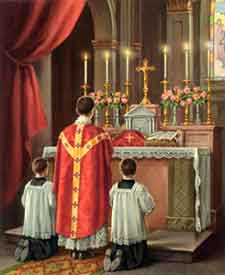
Could this be the Mass of Vatican II?

What follows below is not a homily, nor even a talk. It is the handout I distributed at a parish talk I gave on the liturgical vision of the Second Vatican Council. This was the second talk in a series titled, “Revisiting Vatican II.”
As you can see from the disclaimer at the bottom, I did not present this handout as an indication of what should or should not happen in any particular parish. Before discussing these points, I emphasized that, whatever we think about the rites of the Mass, what is most important is our interior participation. In this regard I appeal especially to the thought of then-Cardinal Ratzinger, who regularly insisted that merely changing the external rites of the Mass will have little effect in bringing about a true liturgical renewal.
For the Holy Father, the “reform of the Reform” begins with education, with rediscovering the true “spirit of the Liturgy” – and this reform is quite distinct from “restoration” in the sense of “going back,” Ratzinger has stated on numerous occasions that it is neither possible nor desirable to “go back.” Indeed, we can only continue forward, toward the Lord, toward to consummation of all history. Yet, we may either go forward with the Pope, or without him; with Vatican II or without it. For my part, I advocate fidelity to the Holy Father and to the teachings of Vatican II – for this reason, it will be helpful to consider what the Second Vatican Council actually said about certain exterior elements of the Sacred Liturgy.
The most important thing today is that we should regain respect for the liturgy and for the fact that it is not to be manipulated. [...] That we do not seek self-fulfillment in it but rather the gift that comes from above. (Joseph Cardinal Ratzinger, God and the World, p. 410)


Myth vs. Fact – What did Vatican II really say about the Mass?
[quotations are from Sacrosanctum Concilium, the Vatican II document on the Liturgy]

Myth: Vatican II got rid of devotions.
Fact: Vatican II said that devotions are necessary, for the Liturgy alone cannot suffice for building up the spiritual life.
9. The sacred liturgy does not exhaust the entire activity of the Church. [...] 12. The spiritual life, however, is not limited solely to participation in the liturgy. [...] 13. Popular devotions of the Christian people are to be highly commended [...] But these devotions should be so drawn up that they harmonize with the liturgical seasons, accord with the sacred liturgy, are in some fashion derived from it, and lead the people to it, since, in fact, the liturgy by its very nature far surpasses any of them. (SC 9, 12, 13)

Myth: Vatican II got rid of Latin.
Fact: Vatican II declared that Latin is the official language of the Mass and must be maintained.
36. 1. Particular law remaining in force, the use of the Latin language is to be preserved in the Latin rites.
2. But since the use of the mother tongue, whether in the Mass, the administration of the sacraments, or other parts of the liturgy, frequently may be of great advantage to the people, the limits of its employment may be extended. This will apply in the first place to the readings and directives, and to some of the prayers and chants, according to the regulations on this matter to be laid down separately in subsequent chapters. [...]
  54. Nevertheless steps should be taken so that the faithful may also be able to say or to sing together in Latin those parts of the Ordinary of the Mass which pertain to them.  (SC 36, 54)

Myth: Vatican II called for modern music to be the norm in the Mass.
Fact: Vatican II insisted that Gregorian Chant (in Latin) must be the norm, though polyphony was also allowed.
116. The Church acknowledges Gregorian chant as specially suited to the Roman liturgy: therefore, other things being equal, it should be given pride of place in liturgical services.
But other kinds of sacred music, especially polyphony, are by no means excluded from liturgical celebrations, so long as they accord with the spirit of the liturgical action. (SC116)

Myth: Vatican II said that modern musical instruments (i.e. the piano, the guitar, etc.) should take the place of traditional instruments (i.e. the organ) in the Mass.
Fact: Vatican II was the first ecumenical council to declare that the pipe organ is the norm.
120. In the Latin Church the pipe organ is to be held in high esteem, for it is the traditional musical instrument which adds a wonderful splendor to the Church's ceremonies and powerfully lifts up man's mind to God and to higher things. But other instruments also may be admitted for use in divine worship. (SC 120)

Myth: Vatican II wanted priests to start “facing the people” during Mass.
Fact: Even according to the current liturgical books, the priest should not celebrate “facing the people”.

Myth: Vatican II insisted on regularly distributing the Precious Blood (i.e. Communion from the cup).
Fact: Vatican II envisioned only certain, very limited, cases when the faithful would receive the Precious Blood.
55. The dogmatic principles which were laid down by the Council of Trent remaining intact, communion under both kinds may be granted when the bishops think fit, not only to clerics and religious, but also to the laity, in cases to be determined by the Apostolic See, as, for instance, to the newly ordained in the Mass of their sacred ordination, to the newly professed in the Mass of their religious profession, and to the newly baptized in the Mass which follows their baptism. (SC 55)

Myth: Vatican II allowed for Communion in the hand.
Fact: There is no mention of this practice in Vatican II. Pope Paul VI specifically warned that this practice could lead to a lack of belief in the Eucharist, and to a loss of reverence.
[In the inscruction Memoriale Domini of 29 May 1969, it is emphasized that the normative way of receiving Communion is on the tongue. Though Paul VI did allow for Communion in the hand, this permission was granted only because some priests and lay faithful (especially in the USA and Europe) had refused to follow the Church’s discipline and demanded Communion in the hand. It was meant as a temporary pastoral concession.]

 – It may be helpful to note Cardinal Ratzinger’s response to the question “How should we actually receive Holy Communion?” The Cardinal’s reply, in part: The signs of reverence we use have changed in the course of time. But the essential point is that our behavior should give to inner recollection and reverence an outward bodily expression. Earlier, Communion used to be received kneeling, which made perfectly good sense. Nowadays it is done standing. But this standing, too should be standing in reverence before the Lord. The attitude of kneeling ought never to be allowed to disappear from the Church.
Another question was brought forward, “Communion in the hand, or directly in the mouth?” Ratzinger’s response, I wouldn’t want to be fussy about that. (from God and the World, pgs. 409-410)

Myth: Vatican II called for the massive renovation of churches; including the removal of statues, altar rails, altars, confessionals, candle stands, etc.
Fact: The Council specifically rejected this notion. Even when certain religious articles would have to be removed, Vatican II specified that they must be disposed of with great dignity.
125. The practice of placing sacred images in churches so that they may be venerated by the faithful is to be maintained. Nevertheless their number should be moderate and their relative positions should reflect right order. [...] 126. Ordinaries must be very careful to see that sacred furnishings and works of value are not disposed of or dispersed; for they are the ornaments of the house of God. (SC 125, 126)

Myth: Vatican II intended to drastically change the Liturgy.
Fact: What was called for was a process of organic growth – slow and gentle modifications and reforms, always maintaining the same essential reality.
21. In order that the Christian people may more certainly derive an abundance of graces from the sacred liturgy, holy Mother Church desires to undertake with great care a general restoration of the liturgy itself. [...] 23. Finally, there must be no innovations unless the good of the Church genuinely and certainly requires them; and care must be taken that any new forms adopted should in some way grow organically from forms already existing. (SC 4, 21, 23)


Joseph Cardinal Ratzinger comments on the liturgical reforms which took place after Vatican II:
One of the weaknesses of the postconciliar liturgical reform can doubtless be traced to the armchair strategy of academics, drawing up things on paper which, in fact, would presuppose years of organic growth. (from Feast of Faith, p. 81)


Disclaimer: I am by no means indicating what should or should not be done in parishes today. Rather, this “myth vs. fact” sheet is simply an indication of what the Second Vatican Council actually said about the Mass. Like any faithful Catholic, I would most certainly hope that we would not reject the teachings and vision which Vatican II has given us – therefore, I take the above quotations very seriously.

It is not what we would like the Council to have said that must determine our course, but what the Council really said. (Joseph Cardinal Ratzinger, Salt of the Earth, p. 261)