Showing posts with label The Mass. Show all posts

Sunday, August 14, 2011

The Jewish heart of Christian prayer, Sermon of August 14th


The Jewish heart of the Mass

20th Sunday in Ordinary Time, Year A
August 14th, 2011
Romans 11:13-15,29-32

For if their [i.e. the Jews’] rejection is the reconciliation of the world, what will their acceptance be but life from the dead? For the gifts and the call of God are irrevocable.

The three readings of today’s Mass bring to the fore this relationship between the Jews and the Gentiles. In the first reading from Isaiah, the Lord tells us my house will be a house of prayer for all peoples. He asserts that all nations and all peoples (that is, the Gentiles) will be incorporated into the covenant which God has formed with the Jews. Again, in the Gospel, our Savior heals the daughter of the Canaanite woman – and we have to recall that the Canaanites were not Jews, but were pagan Gentiles. Here the good Jesus first says that he was sent only to the lost sheep of the house of Israel, but then he grants the prayer of this Gentile woman. The Lord is helping us to learn that the Gentiles will be united to the Jews and become one chosen people with them.

The Letter of St. Paul to the Romans is certainly one of the most theologically complex portions of the Scriptures, and this is seen especially in his discussion of the relation between the Jews and the Gentiles. The Apostle tells us that the Gentiles will not be saved without the Jews – that the Jewish people have, for a time, stumbled; but that they will not fall and be left behind. No, rather, the Jews (as a people) will turn again to the Lord, and this will bring about the final redemption of the whole world.
In a very real sense, Gentile Christians are “spiritual Semites” or “spiritual Hebrews”, as Pope Pius XI stated. We are “spiritual Semites” in the sense that we have been incorporated into the covenant which God established with Abraham and which he made new in Christ Jesus.
Remember, the Savior did not come to abolish the Law and the Prophets, but to fulfill it. And so, the Old Covenant is not so much thrown out, as it is made New!
The Christian faith comes from Judaism and is the fulfillment of that Covenant which God had made with his Chosen People.

So, this is the cosmic dimension of the relation between the Jews and the Gentiles; but what does it mean for us on a more personal level? We can say that Christianity ought to have a Jewish heart. In particular, I would like to point out that all true Christian Prayer has a Jewish heart.
Now, you might be thinking to yourselves – “How can my prayer have a Jewish heart? I don’t speak any Hebrew? What is Jewish about my prayer?”
To that I would respond that we might not even just how Jewish our prayer already is.

The Rosary, it seems to me, is the best example of a common Christian prayer that has a Jewish heart. Many don’t realize it, but the Rosary is a deeply Jewish prayer.
Consider that there are three sets of mysteries and that each set is made up of five decades. That means that, in the core of the Rosary, there are one-hundred fifty “Hail Mary” prayers said. And why do we have this number, one-hundred fifty? It is a commemoration of the one-hundred and fifty Psalms which the Jews would pray every week.
The Psalms were the heart of Jewish prayer, they were at the heart of Jesus’ own prayer – and the Rosary is one very important way that we recall the Jewish roots of our prayer.

What is more, the mysteries of the Rosary are extremely “Jewish” insofar as they remind us of the simple historical fact that Christ was a Jew. Consider the “presentation of Jesus in the Temple” or the “finding of Jesus in the Temple” – these mysteries remind us that our Savior was born a first century Jew.
If we all prayed the Rosary every day – something we most certainly should be doing, especially this month which is dedicated to the Immaculate Heart of Mary – if we all prayed the Rosary every day, we would be much more mindful of the Jewish heart of our prayer.

Now, today, there are certain forms of “Eastern Mysticism” which have become popular even among Catholics – I refer especially to things like “centering prayer” and “yoga”. What should we say about these things?
This is what I will say: These “eastern” forms of prayer are not Christian, they’re not even Jewish. What is more, they are not Christian, precisely because they are not Jewish!
Enough of all this fascination with “eastern” prayer or with “nature worship” – we simply must return to our Jewish roots, and this means especially the Rosary and meditation on the Scriptures.

We also should point out that our public prayer in the Liturgy, should have a Jewish heart. The Mass has a deeply Jewish heart.
When people today, and even some Catholics, try to make the Mass more about “community” than about worship; they are denying the Jewish roots of the Mass. The Jews understood worship to be primarily a matter of offering sacrifice, and the traditional Catholic approach to the Mass emphasizes this point. The Mass is a sacrifice; first and foremost, the Mass is a sacrifice of worship, the sacrifice of the Cross.
A first century Jew would be scandalized by the way many Catholics approach the Mass today – as though it is a casual meal. Not at all! Let it not be so! We are losing the Jewish roots of the Mass.

Let’s look at a couple of particulars: Almost everything we do at the Mass comes from the Jewish worship. Consider the whole structure of the Church – there is the nave (the part of the church building where the people sit) and there is the sanctuary (where the altar is, where the Mass is offered). This corresponds to the structure of the ancient Jewish Temple. There was the place of the people and there was the Holy of Holies which was set apart by a wall and a veil. There was a clear distinction between the place where the people gathered and the place where the altar was – and yet, both priest and people were united in one common prayer.
Now, I know this might be a bit controversial, but it must be said: It was a mistake to remove the altar rails from the churches.  Taking out the altar rail was one step in utterly destroying the Jewish roots of the Liturgy, because it denies the connection between the Jewish “Holy of Holies” and the Catholic sanctuary.

Again, there was a time when people wanted to make the altar in the church look more like a table – removing the beautiful stone altars and replacing them with altars that looked more like wooden dinner tables. This was a mistake, it was a denial of the Jewish roots of the Mass. There wasn’t a wooden table in the Jewish Temple, there was a stone altar! It is a place of offering sacrifice, and a sacrifice requires an altar.
Now you might say, “But, Father, the Mass is a supper and a meal!” And I say, “It is no mere supper, it is the ‘Wedding Feast of the Lamb’ – happily, the new translation will correct this common error.” The Mass isn’t a casual meal or a common supper; it is a feast, a wedding feast! This is the difference between a lunch and a feast: A feast if filled with all sorts of solemnity, everyone has their proper roles and all respect the traditions. The Mass is a feast and a sacrifice, and the only way we are going to understand the Jewish heart of the Mass is if we regain the sense of the sacred and the sense of solemnity which was so honored in our tradition.

Remember, Jesus was not born as the son of a Roman Emperor, and he was not born as a 21st Century American; no, he was born a first century Jew. It is far time for us to recall this fact, to return to the Jewish heart of worship – then we will come to understand that all of history rests with the Jews.


Wednesday, July 27, 2011

The pearl of great price: The Eucharist, the child, the poor. Sermon of July 24th


St. Anthony of Egypt sold all he had, entered the desert,
and endured every trial with joy - he had found the pearl of great price!

17th Sunday in Ordinary Time, Year A
July 24th, 2011
Matthew 13:44-52

The kingdom of heaven is like a treasure buried in a field which a person finds and hides again, and out of joy goes and sells all that he has and buys that field.
Again, the kingdom of heaven is like a merchant searching for fine pearls. When he finds a pearl of great price, he goes and sells all that he has and buys it.

When we hear the parables of the treasure and of the pearl, and learn how we are to be ready to sacrifice all things for the sake of the Kingdom of heaven, we may recall the memory of St. Anthony of the Desert – the Father of Monasticism, who lived at the turn of the 4th century.
St. Anthony was only a young man, about 18 years old, when his parents both died and he was left an orphan. Wondering what the good Lord desired of him, he felt inspired to go to the church. Upon entering, Anthony heard the words of St. Matthew’s Gospel being proclaimed: If thou wilt be perfect, go sell what thou hast, and give to the poor, and thou shalt have treasure in heaven: and come follow me.

The young St. Anthony was deeply moved by these words and felt inspired to give generously to the poor. You see, his family had been very wealthy, so he sold a good portion of his inheritance and gave it to the poor.
However, he did not give everything away – perhaps he was thinking, “Lord, if you are really serious, if you want me to give over everything; you are ‘gonna have to say it directly!”
[those, of course, are my own words … I doubt St. Anthony would have put it quite that way!] J

Shortly thereafter, Anthony again entered the Church and heard the words of St. Luke’s Gospel: Take nothing for your journey; neither staff, nor scrip, nor bread, nor money; neither have two coats.
Deeply moved by the Holy Spirit, St. Anthony immediately went forth, sold what little inheritance was left to him, and gave the money to the poor. Then, this heroic soldier of Christ, left the world and entered the desert as a hermit. There he would remain for nearly 100 years!
Many people came to St. Anthony to seek his counsel, and he ultimately founded the first monasteries in the history of the Church. Was it easy? Of course it wasn’t easy! He lived in the desert of Egypt! It was very hard, he suffered much, he was bothered by all sorts of crazy people coming and pestering him. And, on top of all that, he suffered terribly from the attacks of demons!
But St. Anthony persevered through all of this because he was filled with a profound spirit of joy. He had found that treasure, he had taken possession of the pearl – having left all things, he obtained the Kingdom.

Now, most of us are not called to seek the pearl and the treasure out in the desert. Surely, some here are called in this way – there are likely some among our young men and women who are called to leave all and follow God through the vocation to the religious life or to the priesthood. But most of us will search for the treasure in the ordinary circumstances of daily life. Where then shall we find the Kingdom in midst of the world?
I want to point out three places where we find the treasure, where we gain that pearl – and these are three occasions which are common and ordinary.

First, we find the treasure in the Sunday Mass. If the Eucharist isn’t the pearl of great price, I don’t know what is! It is at the Mass that we gain the riches of everlasting life. Here, in our Sunday worship, we store up treasures in heaven.
How valuable the Mass is! There is nothing more important in our week than Sunday Mass
In fact, Sunday Mass (or Mass on Saturday evening) is so valuable … why, it’s even more important than hunting and fishing season! J
The Eucharist is so important, that we wouldn’t ever want to miss it or skip out on the Mass in order to fish or hunt. If we truly understood the value of the Mass and the Gift that we receive, we would never skip Mass – not for travel, not for vacation, not for games.
Remember, this isn’t just about an obligation (though, it is an obligation); we are talking about the treasure and about the pearl – we have found the Kingdom, be filled with joy and give all things in order to attend Sunday Mass every week without exception.

Second, we find the pear of great price in all the good things that God has in store for marriage and family life. If the child isn’t the pear, I don’t know what is! The gift of the child, how could we ever reject the child?!
And yet, far too often, many people (and even many Catholics) refuse to accept the gift of children. Using artificial means of regulating fertility is like finding the treasure and abandoning it. If we knew the gift of the child, we would never use birth control. A nation which uses contraception is a nation which has rejected the child.
God wants us to trust in him! Will it be hard? Of course it will be hard! Remember, Anthony was in the desert for 100 years; it wasn’t easy, but he was joyful. So too, we also must be joyful – consider the gift of the child and the grace of God who will always provide for us, if only we trust in him.
The way to space out children and to be responsible in parenting is to use Natural Family Planning, not contraception. Natural Family Planning is the great means for parents to find the treasure of the Kingdom and to receive God’s plan for their family with joy.

Third, we find the treasure in being generous to the poor. The poor are that treasure hidden in society, neglected and ignored by so many. If we cannot see that the poor are that pearl, then we have missed Christ who is present to us through them.
The US Dollar is losing strength every day – I hear that it is worth less even than the Canadian Dollar. You may as well give your money to the poor before it is worth nothing at all! J
Mercy covers a multitude of sins, and those who are generous to the poor are the true friends of God.

Finally, if we really believe that these three – the Mass, the child, and the poor – truly are the pearl and the treasure, then we ought to be filled with joy! Here is our means of attaining to the Kingdom of God, which is worth more than any passing treasures of earth; let us sacrifice all our self-love, all our selfishness, all our distrust. You will lose nothing, but you gain everything! And, consumed with the joy of God’s Kingdom, we should be bold in speaking of these things with others.
If we believe that the Eucharist is the great Gift that it is, we will try to bring fallen-away Catholic back to Mass. If we know that the child is a pearl given us by the Lord, we will not be afraid to proclaim the truth about marriage and family, and to encourage others to use Natural Family Planning [and parents and grandparents have a special obligation to explain this to their children]. Finally, if we know that the downtrodden are that true treasure, we will not be ashamed to defend the poor and to be a witness of God’s preferential love for them.
Be joyful! Though these pearls and treasures may only be obtained through much sacrifice, if only you preserver in God’s love, you shall soon attain to life everlasting.


Monday, March 28, 2011

What Vatican II really said about the Mass

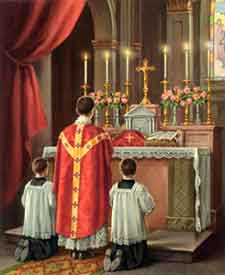
Could this be the Mass of Vatican II?

What follows below is not a homily, nor even a talk. It is the handout I distributed at a parish talk I gave on the liturgical vision of the Second Vatican Council. This was the second talk in a series titled, “Revisiting Vatican II.”
As you can see from the disclaimer at the bottom, I did not present this handout as an indication of what should or should not happen in any particular parish. Before discussing these points, I emphasized that, whatever we think about the rites of the Mass, what is most important is our interior participation. In this regard I appeal especially to the thought of then-Cardinal Ratzinger, who regularly insisted that merely changing the external rites of the Mass will have little effect in bringing about a true liturgical renewal.
For the Holy Father, the “reform of the Reform” begins with education, with rediscovering the true “spirit of the Liturgy” – and this reform is quite distinct from “restoration” in the sense of “going back,” Ratzinger has stated on numerous occasions that it is neither possible nor desirable to “go back.” Indeed, we can only continue forward, toward the Lord, toward to consummation of all history. Yet, we may either go forward with the Pope, or without him; with Vatican II or without it. For my part, I advocate fidelity to the Holy Father and to the teachings of Vatican II – for this reason, it will be helpful to consider what the Second Vatican Council actually said about certain exterior elements of the Sacred Liturgy.
The most important thing today is that we should regain respect for the liturgy and for the fact that it is not to be manipulated. [...] That we do not seek self-fulfillment in it but rather the gift that comes from above. (Joseph Cardinal Ratzinger, God and the World, p. 410)


Myth vs. Fact – What did Vatican II really say about the Mass?
[quotations are from Sacrosanctum Concilium, the Vatican II document on the Liturgy]

Myth: Vatican II got rid of devotions.
Fact: Vatican II said that devotions are necessary, for the Liturgy alone cannot suffice for building up the spiritual life.
9. The sacred liturgy does not exhaust the entire activity of the Church. [...] 12. The spiritual life, however, is not limited solely to participation in the liturgy. [...] 13. Popular devotions of the Christian people are to be highly commended [...] But these devotions should be so drawn up that they harmonize with the liturgical seasons, accord with the sacred liturgy, are in some fashion derived from it, and lead the people to it, since, in fact, the liturgy by its very nature far surpasses any of them. (SC 9, 12, 13)

Myth: Vatican II got rid of Latin.
Fact: Vatican II declared that Latin is the official language of the Mass and must be maintained.
36. 1. Particular law remaining in force, the use of the Latin language is to be preserved in the Latin rites.
2. But since the use of the mother tongue, whether in the Mass, the administration of the sacraments, or other parts of the liturgy, frequently may be of great advantage to the people, the limits of its employment may be extended. This will apply in the first place to the readings and directives, and to some of the prayers and chants, according to the regulations on this matter to be laid down separately in subsequent chapters. [...]
  54. Nevertheless steps should be taken so that the faithful may also be able to say or to sing together in Latin those parts of the Ordinary of the Mass which pertain to them.  (SC 36, 54)

Myth: Vatican II called for modern music to be the norm in the Mass.
Fact: Vatican II insisted that Gregorian Chant (in Latin) must be the norm, though polyphony was also allowed.
116. The Church acknowledges Gregorian chant as specially suited to the Roman liturgy: therefore, other things being equal, it should be given pride of place in liturgical services.
But other kinds of sacred music, especially polyphony, are by no means excluded from liturgical celebrations, so long as they accord with the spirit of the liturgical action. (SC116)

Myth: Vatican II said that modern musical instruments (i.e. the piano, the guitar, etc.) should take the place of traditional instruments (i.e. the organ) in the Mass.
Fact: Vatican II was the first ecumenical council to declare that the pipe organ is the norm.
120. In the Latin Church the pipe organ is to be held in high esteem, for it is the traditional musical instrument which adds a wonderful splendor to the Church's ceremonies and powerfully lifts up man's mind to God and to higher things. But other instruments also may be admitted for use in divine worship. (SC 120)

Myth: Vatican II wanted priests to start “facing the people” during Mass.
Fact: Even according to the current liturgical books, the priest should not celebrate “facing the people”.

Myth: Vatican II insisted on regularly distributing the Precious Blood (i.e. Communion from the cup).
Fact: Vatican II envisioned only certain, very limited, cases when the faithful would receive the Precious Blood.
55. The dogmatic principles which were laid down by the Council of Trent remaining intact, communion under both kinds may be granted when the bishops think fit, not only to clerics and religious, but also to the laity, in cases to be determined by the Apostolic See, as, for instance, to the newly ordained in the Mass of their sacred ordination, to the newly professed in the Mass of their religious profession, and to the newly baptized in the Mass which follows their baptism. (SC 55)

Myth: Vatican II allowed for Communion in the hand.
Fact: There is no mention of this practice in Vatican II. Pope Paul VI specifically warned that this practice could lead to a lack of belief in the Eucharist, and to a loss of reverence.
[In the inscruction Memoriale Domini of 29 May 1969, it is emphasized that the normative way of receiving Communion is on the tongue. Though Paul VI did allow for Communion in the hand, this permission was granted only because some priests and lay faithful (especially in the USA and Europe) had refused to follow the Church’s discipline and demanded Communion in the hand. It was meant as a temporary pastoral concession.]

 – It may be helpful to note Cardinal Ratzinger’s response to the question “How should we actually receive Holy Communion?” The Cardinal’s reply, in part: The signs of reverence we use have changed in the course of time. But the essential point is that our behavior should give to inner recollection and reverence an outward bodily expression. Earlier, Communion used to be received kneeling, which made perfectly good sense. Nowadays it is done standing. But this standing, too should be standing in reverence before the Lord. The attitude of kneeling ought never to be allowed to disappear from the Church.
Another question was brought forward, “Communion in the hand, or directly in the mouth?” Ratzinger’s response, I wouldn’t want to be fussy about that. (from God and the World, pgs. 409-410)

Myth: Vatican II called for the massive renovation of churches; including the removal of statues, altar rails, altars, confessionals, candle stands, etc.
Fact: The Council specifically rejected this notion. Even when certain religious articles would have to be removed, Vatican II specified that they must be disposed of with great dignity.
125. The practice of placing sacred images in churches so that they may be venerated by the faithful is to be maintained. Nevertheless their number should be moderate and their relative positions should reflect right order. [...] 126. Ordinaries must be very careful to see that sacred furnishings and works of value are not disposed of or dispersed; for they are the ornaments of the house of God. (SC 125, 126)

Myth: Vatican II intended to drastically change the Liturgy.
Fact: What was called for was a process of organic growth – slow and gentle modifications and reforms, always maintaining the same essential reality.
21. In order that the Christian people may more certainly derive an abundance of graces from the sacred liturgy, holy Mother Church desires to undertake with great care a general restoration of the liturgy itself. [...] 23. Finally, there must be no innovations unless the good of the Church genuinely and certainly requires them; and care must be taken that any new forms adopted should in some way grow organically from forms already existing. (SC 4, 21, 23)


Joseph Cardinal Ratzinger comments on the liturgical reforms which took place after Vatican II:
One of the weaknesses of the postconciliar liturgical reform can doubtless be traced to the armchair strategy of academics, drawing up things on paper which, in fact, would presuppose years of organic growth. (from Feast of Faith, p. 81)


Disclaimer: I am by no means indicating what should or should not be done in parishes today. Rather, this “myth vs. fact” sheet is simply an indication of what the Second Vatican Council actually said about the Mass. Like any faithful Catholic, I would most certainly hope that we would not reject the teachings and vision which Vatican II has given us – therefore, I take the above quotations very seriously.

It is not what we would like the Council to have said that must determine our course, but what the Council really said. (Joseph Cardinal Ratzinger, Salt of the Earth, p. 261)

Wednesday, November 17, 2010

When Confession is needed before receiving Communion

24th Sunday in Ordinary Time, Year C.
September 12, 2010
Luke 15:1-32, The parable of the prodigal son

While he was still a long way off, his father caught sight of him, and was filled with compassion. He ran to his son, embraced him and kissed him … Then the celebration began.

There is a very popular saying about love, which goes like this: “Love means never having to say you’re sorry.”
My brothers and sisters, that is a lie. Love is not opposed to apologizing. Anyone who is married knows from concrete experience that love often requires us to say “Sorry”.
In fact, true sorrow can only come from true love; and perfect sorrow comes from perfect love. Sorrow is an expression of love. True sorrow heals and restores true love.

How well this is expressed by the parable of the prodigal son. It is love which leads the wayward son to have the confidence to return to his father and to ask for mercy. The son realizes that he does love his father and that he is heartily sorry for having offended him; what is more, the son also knows that his father truly loves him and will forgive him.
Even before the son has reached the house, the father runs out to meet him and welcomes his son with the embrace of love. The father has loved his son even when he was astray, now his love is complete as he forgives his son and draws him back into the family.

This is a very beautiful and encouraging parable – it teaches us so much about God’s forgiveness and mercy – but I would like to focus on one specific aspect of the story. Notice that the boy, when returning, is first greeted by his father and forgiven, and only then does he enter the house. First he receives forgiveness, then he enters for the feast.
Consider how inappropriate it would have been if the prodigal son would have simply come into the house without having apologized to his father, without first receiving forgiveness. It would have been terrible!
It is very clear: First forgiveness, then the feast. First confession, then communion.

This is why, at Mass, we begin with the penitential rite – conscious of our sinfulness and our need for God’s forgiveness, we say, “Lord, have mercy. Christ, have mercy. Lord, have mercy.” We recognize the need to say “Lord, I am sorry, have mercy on me, forgive me.” We must be reconciled with God; we must first receive his forgiveness, then we come to the feast of heaven.

However, we must also recognize that for serious sins, the Lord has given us a special sacrament which we must make use of before coming to Communion. I am referring to the sacrament of Confession. After committing serious sins, the Church requires that we go to Confession before coming to Communion. It is just like in the parable – first Confession, then Communion.
Now I know that this has not been preached about very much, and perhaps this is the first time some of you have heard this teaching. I don’t know why so few priests are speaking about it… The Catechism is very clear on this point, paragraph 1385 states: “Anyone conscious of a grave sin must receive the sacrament of Reconciliation before coming to Communion.” Even the music books (Breaking Bread, OCP) in the pews state this in equally strong language on the inside of the front cover, under the “Guidelines for the reception of Communion, for Catholics.”
After committing a serious sin, we cannot receive Communion without having first gone to Confession. Instead, we must either remain in the pew or, if staying in the pew would be too difficult, we may come up and cross our arms to receive a blessing – but we must not take Communion when we have serious sin on our souls.

Now some will say, “But I have asked God for forgiveness in my heart, isn’t that enough?” Perhaps God has forgiven you, in your heart. However, if we have made only a “spiritual confession”, we are able only to make a “spiritual communion”; forgiveness in the heart can only lead to communion in the heart – thus, I would recommend offering special prayers to Jesus and professing your love for him, but one must not receive him in Sacramental Communion without Sacramental Confession.
If we want to receive Christ in the Sacrament of the Eucharist, we must first receive his forgiveness in the Sacrament of Confession. If we desire to take Communion from the hands of the priest at Mass, we must first receive forgiveness from the hands of the priest in Confession.
My brothers and sisters, nothing is more effective in leading us to holiness and union with Christ than a good and worthy Communion. Nothing is more valuable before God than receiving the Eucharist in the state of grace and in a worthy manner.
On the other hand, nothing will destroy our union with Christ more than an unworthy Communion. Nothing is more effective in separating us from Christ and plunging us into the depths of hell than taking Communion after having committed serious sin and not having gone to Confession.
Let us make no mistake, a good and worthy Communion is everything! Everything relies upon the Most Blessed Sacrament of the altar!

But let’s get real practical. I would like to list three serious sins, sins which are very common and which must be confessed before we come to Communion. Certainly, there are many other sins, and there are even many other worse sins, but I mention these three because they are so common and so often misunderstood. Everything I say here is from the Catechism; it is not my opinion, it is the clear teaching of Christ and his Church.

First, skipping Sunday Mass. To skip Mass on Sunday, without a grave reason, is a very serious sin.  If we skip Sunday Mass, we must not come to Communion until after first going to Confession.
Second, any sin against the 6th Commandment; that is, any external sexual sin either alone or with another person – I think you all know what sort of sins I am referring to here. Sins against chastity are very serious. We must confess any external sin against chastity before we come to Communion.
Finally, drunkenness and drug abuse. By drunkenness, I do not mean simply being a bit tipsy or loopy; I am talking about real intoxication, a loss of reason. To intentionally get drunk or abuse drugs is a serious sin, it must be confessed before coming to Communion. Moreover, to drive while under the influence is a serious sin – one must first go to Confession before coming to Communion.

I do not say this to be hard or difficult. This is a teaching of love! It is all about forgiveness and communion. But we must come to Christ in the proper order – we must approach God in a worthy and holy manner.
Be sure of this: The good and worthy Communions we make in this life will bring us all to the glory of life everlasting.


Sunday, October 24, 2010

To whom do you pray during Mass?

30th Sunday in Ordinary Time, Year C.
October 24th, 2010
Luke 18: 9-14, The parable of the Pharisee and the tax collector

The Pharisee took up his position and spoke this prayer to himself…

Of the many themes that the parable of today’s Gospel brings up, I would like to focus specifically on the prayer of the Pharisee and, in fact, on one small aspect of that prayer. Notice that our Savior tells us that the Pharisee spoke the prayer to himself. He does not speak to God or pray to God, he speaks and prays to himself. And, if we look at the words of his prayer, we see that the Pharisee is really worshiping not God, but himself.
This is an example of bad prayer and bad worship – this is how we ought not to pray. But what is bad worship? Bad worship and bad prayer is self-serving and self-satisfied. Bad worship is dictated by our likes and dislikes rather than by the teaching of the Gospel and the Tradition of the Church. Bad worship is very sentimental. Moreover, bad worships is a lot of fun – notice that the Pharisee enjoyed his time in the Temple area much more than the tax collector. Bad worship is socially acceptable and very popular.

Here is a little story to illustrate bad worship: After Sunday Mass a family – a husband and wife and a young boy – are all driving home. Scarcely do they pull away from the Church and the father begins to complain about the music. Then the wife says, “If the music was bad, that homily was even worse!” And on and on, they went back and forth. Eventually, the parents stopped talking and, after a brief moment of silence, the little boy in the back piped up and said, “Well, I don’t think it was too bad, for a buck!” J
Obviously, this is a silly little joke; but I think there is something more profound here as well. Do we think of worship as entertainment? Do we come to the Mass the same way we would go to a movie – giving our money and expecting a good show? There is, for all of us, room for growth and for purification.

Bad worship is, in fact, a great problem among the Protestants and, especially, among the Evangelical so-called “Bible” churches. Sure, these churches are packed (with a lot of ex-Catholics, I might add!) and the music is great. The sermons are exciting and the service is a lot of fun – their youth group is huge. You can even get your cup of coffee on the way in…
But, I ask, does anyone go home justified? Certainly not by that style of worship…it is bad worship, it is dictated by the trends of the day.
This can be a problem in the Catholic Church as well. There is a real tendency in the modern Church to become “fashionable” and focused on the momentary tastes of the time, rather than on the Church’s venerable Tradition.

I look at many churches and I wonder – the priest is looking at the people and the people are looking at the priest, but is anyone looking to God? The priest speaks to the people and the people speak to the priest, but is anyone speaking to God? True worship is a disposition of the heart that must be fostered.
For 2000 years, and even in our own day, the Church honors the Liturgical practice called ad orientem – this is the posture of prayer where the priest and the people all face in the same direction, toward the East and toward the Crucifix. The priest and the people, looking together and praying together, worship God. Some people, rather foolishly, will say that the priest “has his back to the people.” That is just ridiculous! It’s not so much that the priest is facing away from the people, as with the people – they aren’t worshiping him, after all, they are worshiping God; and he should be worshiping together with them, as a member of the same Body!

What is important here is not so much the particular externals of this Liturgical practice, the real point is the fundamental attitude which we must adopt during worship. We are not simply speaking back and forth, we are not meant to be turned in on ourselves or our community; we must look to the Lord, worship the Lord, and speak our prayer to the Lord.
May the grace and the love of Christ Jesus, form us interiorly and lead us to a deeper participation in the true spirit of the Liturgy.


Tuesday, October 12, 2010

Sermon on gratitude

28th Sunday in Ordinary Time, Year C.
October 10th, 2010
Luke 17:11-19, The cleansing of the ten lepers

Jesus said in reply, “Ten were cleansed, were they not? Where are the other nine? Has none but this foreigner returned to give thanks to God?”

All of us can recall the experience from our own childhood – and those of you who are parents know of it from another perspective – the experience of learning to say “Thank you”. When receiving a gift from a parent or a friend or from another adult, children often have to be reminded by their mother or father, “What do you say?” And, of course, the child slowly learns how to be gracious, how to express gratitude. The boy or girl learns to give thanks.
I bring this experience to mind because I think that there is something of an analogy between the parent teaching the child to say “Thank you” and the words of our Savior in today’s Gospel. We must recognize that parents do not make the child say “Thank you” because they need to feel better about themselves – it’s not really for their sake at all, but for the sake of their son or daughter. Parents know that they have to teach their children to express gratitude because, without this habit, one cannot be successful in human relationships. The parents insist on the words “Thank you”, because they want what is best for their children.

While we might be a bit surprised at how strongly Christ speaks in the Gospel today – for, indeed, he seems outraged and dejected that none but the Samaritan has returned to offer thanks – we must also recognize that our Lord is not upset because he feels put-out or underappreciated. Christ does not require the thanks and praise of any human being; even as a man, he has received all glory from his heavenly Father. Rather, the Lord is dejected because he had given these ten lepers the gift of the healing of their bodies, but he wanted to give them another even greater gift – the healing of their souls, through faith.
Because the nine did not return to give thanks, they received only the first gift, the bodily gift, and they lost the opportunity for grace. Jesus is upset because he had wanted to give them so much more, but they would not receive it.

We have taken the part of the Samaritan who returned to bless God, we have gathered here today to worship and to give thanks. The Mass is characterized by this spirit of thanksgiving. We praise and bless God for all his gifts and we implore his continued protection and guidance. As I am sure many of you know, the very word “Eucharist” means “thanksgiving”.
And, wonder of wonders, as we return to give thanks for God’s blessings, we receive a gift more precious than all else – we receive the very Body and Blood of Christ. In our act of thanksgiving, we are given a blessing of infinite value.

And yet, we must notice this tension – though the Mass is certainly the greatest action we can possibly perform, it is yet only a very small part of our week. Even if we attend daily Mass, we probably spend less than an hour a day in Liturgical worship and thanksgiving. We must ask ourselves: “How can I take the spirit of thanksgiving and praise which is present at the Mass and extend it into my daily life? How can I truly ‘go forth in the peace of Christ’?”
In this regard, G.K. Chesterton, a Catholic author of the early 1900’s in England, can be of great assistance. He tells, if we are thankful for the beauty of nature, let us follow the law of nature. If we are grateful for the gift of grace and redemption won for us in Christ Jesus, let us follow the Law of Christ and of his Church! The Lord himself has told us, “If you love me, keep my commandments.” This is the true expression of gratitude that must permeate our lives – we thank God for his gifts, by using his blessings according to his command, knowing that all he commands is for our benefit.

It is true that certain teachings of the Church and of the Gospel are not always immediately clear to us. Perhaps we do not fully understand why some things are required and other things are outlawed. Indeed, even when we do understand, it can be difficult to follow the Law of Christ in the midst of the world’s temptations. But this is where the spirit of thanksgiving assists us.
The love and thanksgiving which leads us to follow God’s Law brings us joy and peace, even when things are difficult. By that spirit of gratitude, what might have been heavy is made light, what could have been bitter is made sweet, and the commandments and precepts of Christ and of his Church become our joy.

May this true spirit of thanksgiving, which is itself a gift from On High, inflame our hearts with the Love of Christ and help us to grow in his grace.