Showing posts with label The Rosary. Show all posts

Tuesday, August 30, 2011

Priests need to preach against contraception, Sermon on the Feast of St. John the Baptist


The following is the summary of my daily Mass homily from this past Monday

August 29th, Feast of the Beheading of St. John the Baptist

St. John the Baptist was the great Forerunner of our Lord – he preceded the Savior in his conception and birth, in his ministry and death. Today we celebrate the feast of the martyrdom of the greatest of the prophets, he who was the voice crying in the wilderness, “Prepare the way of the Lord.”

It is quite interesting to note, however, that St. John the Baptist did not die explicitly for his confession of the Christ – rather, he suffered and was killed on account of his defense of the sanctity of marriage. When King Herod married his deceased brother’s wife, Herodias, St. John pointed out that this was an unlawful marriage. And, while Herod always maintained a certain curiosity about John (proving that his own conscience was telling him that the Baptist was right), Herodias hated John vehemently.
And so, John the Baptist was arrested and imprisoned on account of the rage of Herodias – ultimately, he suffered martyrdom by beheading at the insistence of this vile woman and her daughter.

John did not die explicitly for his proclamation of the coming of the Messiah, but he was martyred for his witness to the truth about marriage and family – and, in this respect, he is a prophet of the grace which would come through the sacrament of Christian Marriage which Christ Jesus would institute.
John the Baptist died as a martyr for the dignity and sanctity of marriage and family life. In this respect, John is a great example for parish priests.
Consider the many parallels between the Baptist and the priest: Like the priest, John was celibate and, as a celibate, he was able to speak clearly and convincingly about married life. Like the priest, John was removed from society (both by his manner of dress and by the fact that he lived a desert life which was separated from the daily concerns of the consumer culture) and, precisely because he was in the world but not of the world, John was able to call men and women to a radical holiness.
There are, of course, many more parallels besides.

John died as a martyr, that is a “witness”, to the sanctity of marriage and family life. So too, the parish priest is dedicated in a particular way to helping the faithful to fulfill their vocations, especially the vocation to marriage (since most of the faithful in his parish will be called to the married state).
God gives us priests in order to help us become saints – that is what priests are for, to help us get to heaven. But we can only become saints through living out our own vocation well: A monk cannot be a saint by living like a married man, and a wife cannot become a saint by living like a cloistered nun. The job of the priest is to help each individual in his parish to live out the vocation to which God has called him. And, for the majority of the parishioners, this means learning to live holiness in the context of family life: Either as the husband or wife, or even as the child.
The only way that a priest is going to help people become saints is for him to hold up and defend the dignity and the sanctity of marriage and family life as a true means of growing in holiness.

We need to pray that our priests would follow the example of St. John the Baptist and be fearless in proclaiming all that God has to offer us in marriage and in the family. We need to pray that the good Jesus would strengthen our priests so that they might be clear and bold in teaching the truth about the family – both from the pulpit and (especially) in the confessional.
St. John Vianney once said, “There are no priests, only priests for whom there is not enough prayer.” Yes, let us pray for our priests, and pray the good Lord to send us more priests – that, through the intercession of St. John the Baptist, we might be granted true shepherds who will help our parishes to thrive and to grow in holiness through living out the vocation of marriage and family life according to the divine law.

But we need to be more specific. There are two areas which we really need priests to speak about with greater clarity and boldness – and always, always, always with charity!
First, there is the Church’s teaching on contraception. Contraception is destroying our marriages, ruining our families, corrupting the faithful, and (quite frankly) bringing great and terrible sorrows upon us all. We can scarcely imagine just how great an evil contraception is in our society and (sadly) in our Church.
And yet, many will say that contraception is “the Church’s worst kept secret.” I call it a “secret” insofar as nobody is talking about it – priests don’t preach on it, priests don’t ask about it in the confessional, parents neglect their duty and obligation to teach the truth to their children; almost nobody at all is speaking about contraception. And so, it is a “secret”.
However, I say it is the “worst kept secret” because, even though nobody ever talks about it or gives the Church’s official teaching – everybody knows it! Everybody (or nearly everybody) knows that the Church is against contraception – it seems that we’ve all just agreed to wink and smile and ignore our Mother.

Contraception cannot remain the “worst kept secret” any longer. The wreckage which contraception has caused in families and marriages has to stop. And so, pray. Pray, pray, pray! Pray the good Jesus to convert our priests and to give them the strength to follow St. John the Baptist in proclaiming the truth no matter what the cost.
Pray also that the Lord would send us more good and holy priests who will preach the truth with love and free our Church from this terrible scourge.

And finally, if only very briefly, we must mention the family Rosary. How can we every make it as a Christian family without the Rosary? And yet, how rare it is to hear priests preach about the Rosary or tell our mothers and fathers of the importance of gathering as a family every day to pray the Rosary together. How many graces are lost!
Pray the good Lord that he would strengthen and inspire his priests to preach the family Rosary with greater zeal, confidence, and love. Imagine all the good things our Jesus wants to pour out upon our families, if only we would pray!

St. John the Baptist was willing to lay down his life in defense of marriage and the family. Let us pray the Almighty Father to send his Church priests after the Heart of his own Son – priests who will bring about a renewal in marriage and family life, no matter what the cost; priests who will lay down their lives for the sheep.

Sunday, August 14, 2011

The Jewish heart of Christian prayer, Sermon of August 14th


The Jewish heart of the Mass

20th Sunday in Ordinary Time, Year A
August 14th, 2011
Romans 11:13-15,29-32

For if their [i.e. the Jews’] rejection is the reconciliation of the world, what will their acceptance be but life from the dead? For the gifts and the call of God are irrevocable.

The three readings of today’s Mass bring to the fore this relationship between the Jews and the Gentiles. In the first reading from Isaiah, the Lord tells us my house will be a house of prayer for all peoples. He asserts that all nations and all peoples (that is, the Gentiles) will be incorporated into the covenant which God has formed with the Jews. Again, in the Gospel, our Savior heals the daughter of the Canaanite woman – and we have to recall that the Canaanites were not Jews, but were pagan Gentiles. Here the good Jesus first says that he was sent only to the lost sheep of the house of Israel, but then he grants the prayer of this Gentile woman. The Lord is helping us to learn that the Gentiles will be united to the Jews and become one chosen people with them.

The Letter of St. Paul to the Romans is certainly one of the most theologically complex portions of the Scriptures, and this is seen especially in his discussion of the relation between the Jews and the Gentiles. The Apostle tells us that the Gentiles will not be saved without the Jews – that the Jewish people have, for a time, stumbled; but that they will not fall and be left behind. No, rather, the Jews (as a people) will turn again to the Lord, and this will bring about the final redemption of the whole world.
In a very real sense, Gentile Christians are “spiritual Semites” or “spiritual Hebrews”, as Pope Pius XI stated. We are “spiritual Semites” in the sense that we have been incorporated into the covenant which God established with Abraham and which he made new in Christ Jesus.
Remember, the Savior did not come to abolish the Law and the Prophets, but to fulfill it. And so, the Old Covenant is not so much thrown out, as it is made New!
The Christian faith comes from Judaism and is the fulfillment of that Covenant which God had made with his Chosen People.

So, this is the cosmic dimension of the relation between the Jews and the Gentiles; but what does it mean for us on a more personal level? We can say that Christianity ought to have a Jewish heart. In particular, I would like to point out that all true Christian Prayer has a Jewish heart.
Now, you might be thinking to yourselves – “How can my prayer have a Jewish heart? I don’t speak any Hebrew? What is Jewish about my prayer?”
To that I would respond that we might not even just how Jewish our prayer already is.

The Rosary, it seems to me, is the best example of a common Christian prayer that has a Jewish heart. Many don’t realize it, but the Rosary is a deeply Jewish prayer.
Consider that there are three sets of mysteries and that each set is made up of five decades. That means that, in the core of the Rosary, there are one-hundred fifty “Hail Mary” prayers said. And why do we have this number, one-hundred fifty? It is a commemoration of the one-hundred and fifty Psalms which the Jews would pray every week.
The Psalms were the heart of Jewish prayer, they were at the heart of Jesus’ own prayer – and the Rosary is one very important way that we recall the Jewish roots of our prayer.

What is more, the mysteries of the Rosary are extremely “Jewish” insofar as they remind us of the simple historical fact that Christ was a Jew. Consider the “presentation of Jesus in the Temple” or the “finding of Jesus in the Temple” – these mysteries remind us that our Savior was born a first century Jew.
If we all prayed the Rosary every day – something we most certainly should be doing, especially this month which is dedicated to the Immaculate Heart of Mary – if we all prayed the Rosary every day, we would be much more mindful of the Jewish heart of our prayer.

Now, today, there are certain forms of “Eastern Mysticism” which have become popular even among Catholics – I refer especially to things like “centering prayer” and “yoga”. What should we say about these things?
This is what I will say: These “eastern” forms of prayer are not Christian, they’re not even Jewish. What is more, they are not Christian, precisely because they are not Jewish!
Enough of all this fascination with “eastern” prayer or with “nature worship” – we simply must return to our Jewish roots, and this means especially the Rosary and meditation on the Scriptures.

We also should point out that our public prayer in the Liturgy, should have a Jewish heart. The Mass has a deeply Jewish heart.
When people today, and even some Catholics, try to make the Mass more about “community” than about worship; they are denying the Jewish roots of the Mass. The Jews understood worship to be primarily a matter of offering sacrifice, and the traditional Catholic approach to the Mass emphasizes this point. The Mass is a sacrifice; first and foremost, the Mass is a sacrifice of worship, the sacrifice of the Cross.
A first century Jew would be scandalized by the way many Catholics approach the Mass today – as though it is a casual meal. Not at all! Let it not be so! We are losing the Jewish roots of the Mass.

Let’s look at a couple of particulars: Almost everything we do at the Mass comes from the Jewish worship. Consider the whole structure of the Church – there is the nave (the part of the church building where the people sit) and there is the sanctuary (where the altar is, where the Mass is offered). This corresponds to the structure of the ancient Jewish Temple. There was the place of the people and there was the Holy of Holies which was set apart by a wall and a veil. There was a clear distinction between the place where the people gathered and the place where the altar was – and yet, both priest and people were united in one common prayer.
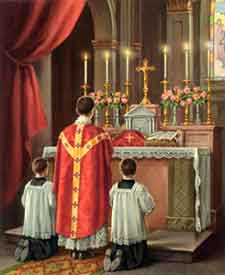
Now, I know this might be a bit controversial, but it must be said: It was a mistake to remove the altar rails from the churches.  Taking out the altar rail was one step in utterly destroying the Jewish roots of the Liturgy, because it denies the connection between the Jewish “Holy of Holies” and the Catholic sanctuary.

Again, there was a time when people wanted to make the altar in the church look more like a table – removing the beautiful stone altars and replacing them with altars that looked more like wooden dinner tables. This was a mistake, it was a denial of the Jewish roots of the Mass. There wasn’t a wooden table in the Jewish Temple, there was a stone altar! It is a place of offering sacrifice, and a sacrifice requires an altar.
Now you might say, “But, Father, the Mass is a supper and a meal!” And I say, “It is no mere supper, it is the ‘Wedding Feast of the Lamb’ – happily, the new translation will correct this common error.” The Mass isn’t a casual meal or a common supper; it is a feast, a wedding feast! This is the difference between a lunch and a feast: A feast if filled with all sorts of solemnity, everyone has their proper roles and all respect the traditions. The Mass is a feast and a sacrifice, and the only way we are going to understand the Jewish heart of the Mass is if we regain the sense of the sacred and the sense of solemnity which was so honored in our tradition.

Remember, Jesus was not born as the son of a Roman Emperor, and he was not born as a 21st Century American; no, he was born a first century Jew. It is far time for us to recall this fact, to return to the Jewish heart of worship – then we will come to understand that all of history rests with the Jews.


Sunday, August 7, 2011

A sermon on Christian meditation from Father Ryan Erlenbush. August 7th


Elijah, praying alone on Mount Horeb

19th Sunday in Ordinary Time, Year A
August 7th, 2011
1 Kings 19:9a, 11-13a; Matthew 14:22-33

At the mountain of God, Horeb, Elijah came to a cave where he took shelter. […] There was a tiny whispering sound. When he heard this, Elijah hid his face in his cloak and went and stood at the entrance of the cave.

Jesus went up on the mountain by himself to pray. When it was evening he was there alone.

Beginning to sink, Peter cried out, “Lord, save me!”

Today’s readings, especially the first reading and the Gospel, teach us the fundamentals of prayer. We see the two essential movements of prayer: First, there is mediation and contemplation – which is shown in Elijah and, most perfectly, in our Savior; it is the example of going up the mountain alone to prayer – and, second, there is supplication or petition – this we see (albeit in an imperfect way) in St. Peter, when he cries out “Lord, save me!”.
These are the two movements: Meditation, which is that mental prayer where we quiet ourselves and enter into loving union with God; and petition, the prayer where we ask the good God to give us all the graces we need for today, for tomorrow, and at the moment of our death.

First, there is mental prayer, that meditation which leads to contemplation. St. John Chrysostom tells us that two things are necessary for true mental prayer – a quiet place, and time. Notice the example of Elijah, the great prophet of the Old Testament. First, he heard the wind which crushed the rocks, but God wasn’t in the wind. Then there was the earthquake and finally also the fire, but God was not in these either. Rather, God came to Elijah in the tine whisper – this is the gentle and often very subtle movement of the Holy Spirit.
If the Holy Spirit is so gentle and often speaks to us through a little whisper, then it is obvious that we will have to listen attentively in order to hear him. We need to quiet ourselves in order to hear his voice and to follow his inspirations.
Today’s world is so busy and loud, we need a quiet place to pray. Of course, the church is a very special place for prayer, but also in our homes we need to take time to step away from the daily duties of life, to retreat to a quiet room, to shut the door, to quiet ourselves and to seek God.

We must point out that every family has not only the right but also the obligation to set aside time for daily meditation or mental prayer. Husbands and wives have a duty to provide each other with time for prayer – and parents with young children should be teaching them how to pray as well.
Of course the family should pray together – we mention especially the family Rosary. If your family is not in the practice of saying the Rosary together every day, the month of August (which is the month dedicated to the Immaculate Heart of Mary) is a great time to start. Perhaps five decades seems like too much at first … fine, we can start with one decade, or at least three Hail Mary’s. Then, we can build from this starting place. Little by little we will grow as a family.
Still, in addition to that common family prayer, the couple must allow each other – and their children as well, once they are old enough – the time for quiet personal prayer and meditation in a separate room apart from the business of the family life.

Now the next question is about time. How much time should we give over to prayer every day? The saints recommend at least fifteen minutes, though twenty would be better. Yes, twenty minutes of quiet reflective meditation every day is so important for us! How can we expect to fulfill all the duties of our daily lives if we are not praying?
Moreover, when we think about how many minutes we should pray, we ought to remember that prayer is all about developing a relationship with the Lord. Could we have a loving intimate relationship with any human being if we only spoke for two or three minutes a day? What if the only time we spoke to our husband was to ask for things, never to simply speak words of Love? Likewise, what if a man only spoke to his wife in a distracted and disinterested manner, perhaps for a few minutes a day or not even every day? This would never work among human being! Why should we think that such little prayer would work with God?
We will say this: If fifteen minutes of prayer every day seems too long, I reply in the spirit of St. Josemaria Escriva – the prayer is not too long, but your love is too short!
Still, we must not be discouraged. If all we can do in the beginning is five minutes, that is fine, it is a place to start. We begin wherever we are and we try to build from there. Sometimes I think that if we only got a little bit better at prayer every day, we would be saints in no time!

And what is this meditation supposed to be about? What are we supposed to do for those twenty minutes every day? We can consider the Rosary – the Rosary will teach us much about the nature of mental prayer and meditation.
When we meditate, we are to consider the mysteries especially of Jesus’ life, death and Resurrection, as well as the other mysteries of our Faith – the Trinity, creation, the final judgment. We think upon these mysteries and we consider the great love that Almighty God has shown us through these events.
Christian meditation is all about love, thinking upon God’s love for us and how he has shown us this love in Christ Jesus – and, filled with the divine love, making small acts of love for God in return. To say, “Jesus, how you have loved me! You love me so much that you have died for me! In turn, let me love you!”

Notice how different Christian meditation is from Eastern forms of prayer. Eastern meditation is all about emptying ourselves, dissolving into the “power” of the Universe, clearing our minds to become nothing. Eastern prayer is self-annihilation, but Christian mediation is focused primarily on being filled! Christian prayer is about being filled with God’s love. Far from clearing our minds and entering into nothingness, Christian meditation is focused on thinking about Jesus, about the mysteries of the Faith, about the love of God; and then making acts of love in return. Finally, Christian meditation culminates in the simple loving gaze of the creature upon his Creator.
How far we are from Eastern prayer, and from such practices as “centering prayer” or “yoga”. Centering prayer and yoga are focused on emptying the self, on clearing the mind so as to think of nothing – this is the opposite of Christian mediation. If we are practicing centering prayer or yoga, we need to cut that out immediately – it has nothing at all to do with the Gospel!
Remember, “Mother Earth” does not love you. I hope you know that “Mother Earth” does not love you – she cannot love you because she is not a person. God, the Most Holy Trinity, is three Persons who love you intensely, who want to be united with you, to dwell in you, to elevate you and glorify you by a share in their own life.

And then, finally and very briefly, we come to the very necessary second movement of prayer: Supplication, the prayer of petition. When we see just how much Jesus loves us, we are then filled with a confidence to ask of him all the graces we need to fulfill our vocation in life.
St. Peter, when he was walking on the water, became troubled and fearful seeing the storm and the waves – we too will have many storms to weather, but like St. Peter will be saved if only we cry to the good Jesus, Lord, save me! This is the prayer of petition – asking for the graces needed in the moment and, especially, for the grace to be united to God at the moment of death.
More than anything else, every day we must ask God to bring us to heaven when we die. We must ask God for the grace of final perseverance, which is the grace to turn to him in the last moment of life and to give ourselves completely over to his love.

Be sure of this, if we do not pray and ask to go to Heaven, we won’t. If we do not beg the Lord for the grace to be faithful to the end, we will certainly be damned. All the saints in Heaven are there for this one reason, they prayed and asked for the grace of salvation. Conversely, all the damned in Hell are there for this one reason, they did not pray and they did not ask for the grace of perseverance.
Do you see? Prayer is everything! Our good God loves us so much and he has so many good things that he wants to give us, if only we would pray, if only we would ask for his benefits. Indeed, if we are filled with the love of God and if we persevere in asking the good Lord to bring us to union with himself, we can be sure that he will give us the great glory of life everlasting.