 |
| The Jewish heart of the Mass |
20th Sunday in Ordinary Time, Year
A
August 14th, 2011
Romans 11:13-15,29-32
For if their [i.e. the Jews’] rejection
is the reconciliation of the world, what will their acceptance be but life from
the dead? For the gifts and the call of God are irrevocable.
The three
readings of today’s Mass bring to the fore this
relationship between the Jews and the Gentiles. In the first reading from
Isaiah, the Lord tells us my house will
be a house of prayer for all peoples. He asserts that all nations and all peoples
(that is, the Gentiles) will be incorporated into the covenant which God has
formed with the Jews. Again, in the Gospel, our Savior heals the daughter of
the Canaanite woman – and we have to recall that the Canaanites were not Jews,
but were pagan Gentiles. Here the good Jesus first says that he was sent only to
the lost sheep of the house of Israel, but then he grants the prayer of this
Gentile woman. The Lord is helping us to
learn that the Gentiles will be united to the Jews and become one chosen people
with them.
The Letter of
St. Paul to the Romans is certainly one of the most theologically complex
portions of the Scriptures, and this is seen especially in his discussion of
the relation between the Jews and the Gentiles. The Apostle tells us that the Gentiles will not be saved without the
Jews – that the Jewish people have, for a time, stumbled; but that they
will not fall and be left behind. No, rather, the Jews (as a people) will turn
again to the Lord, and this will bring about the final redemption of the whole
world.
In a very real
sense, Gentile Christians are “spiritual
Semites” or “spiritual Hebrews”, as Pope Pius XI stated. We are “spiritual
Semites” in the sense that we have been incorporated into the covenant which
God established with Abraham and which he made new in Christ Jesus.
Remember, the
Savior did not come to abolish the Law and the Prophets, but to fulfill it. And
so, the Old Covenant is not so much thrown out, as it is made New!
The Christian
faith comes from Judaism and is the fulfillment of that Covenant which God had
made with his Chosen People.
So, this is the
cosmic dimension of the relation between the Jews and the Gentiles; but what
does it mean for us on a more personal level? We can say that Christianity ought to have a Jewish heart. In particular,
I would like to point out that all true
Christian Prayer has a Jewish heart.
Now, you might
be thinking to yourselves – “How can my prayer have a Jewish heart? I don’t
speak any Hebrew? What is Jewish about my prayer?”
To that I would
respond that we might not even just how Jewish our prayer already is.
The Rosary, it
seems to me, is the best example of a common Christian prayer that has a Jewish
heart. Many don’t realize it, but the Rosary
is a deeply Jewish prayer.
Consider that there
are three sets of mysteries and that each set is made up of five decades. That
means that, in the core of the Rosary, there are one-hundred fifty “Hail Mary”
prayers said. And why do we have this number, one-hundred fifty? It is a commemoration of the one-hundred
and fifty Psalms which the Jews would pray every week.
The Psalms were
the heart of Jewish prayer, they were at the heart of Jesus’ own prayer – and the
Rosary is one very important way that we recall the Jewish roots of our prayer.
What is more, the mysteries of the Rosary are extremely “Jewish”
insofar as they remind us of the simple historical fact that Christ was a Jew.
Consider the “presentation of Jesus in the Temple” or the “finding of Jesus in
the Temple” – these mysteries remind us that our Savior was born a first
century Jew.
If we all prayed
the Rosary every day – something we most certainly should be doing, especially
this month which is dedicated to the Immaculate Heart of Mary – if we all
prayed the Rosary every day, we would be much more mindful of the Jewish heart
of our prayer.
Now, today, there are certain forms of “Eastern
Mysticism” which have become popular even among Catholics – I refer
especially to things like “centering prayer” and “yoga”. What should we say
about these things?
This is what I
will say: These “eastern” forms of
prayer are not Christian, they’re not even Jewish. What is more, they are
not Christian, precisely because they are not Jewish!
Enough of all
this fascination with “eastern” prayer or with “nature worship” – we simply
must return to our Jewish roots, and this means especially the Rosary and
meditation on the Scriptures.
We also should
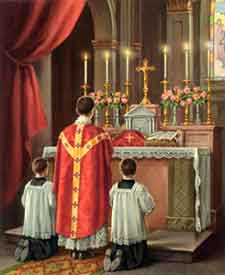
point out that our public prayer in the Liturgy, should have a Jewish heart. The Mass has a deeply Jewish heart.
When people today, and even some
Catholics, try to make the Mass more about “community” than about worship; they
are denying the Jewish roots of the Mass. The Jews understood worship to be primarily a matter of
offering sacrifice, and the traditional Catholic approach to the Mass
emphasizes this point. The Mass is a sacrifice; first and foremost, the Mass is
a sacrifice of worship, the sacrifice of the Cross.
A first century
Jew would be scandalized by the way many Catholics approach the Mass today – as
though it is a casual meal. Not at all! Let it not be so! We are losing the
Jewish roots of the Mass.
Let’s look at a
couple of particulars: Almost everything
we do at the Mass comes from the Jewish worship. Consider the whole
structure of the Church – there is the nave (the part of the church building
where the people sit) and there is the sanctuary (where the altar is, where the
Mass is offered). This corresponds to the structure of the ancient Jewish Temple.
There was the place of the people and there was the Holy of Holies which was set
apart by a wall and a veil. There was a clear distinction between the place
where the people gathered and the place where the altar was – and yet, both
priest and people were united in one common prayer.
Now, I know this
might be a bit controversial, but it must be said: It was a mistake to remove the altar rails from the churches. Taking out the altar rail was one step in
utterly destroying the Jewish roots of the Liturgy, because it denies the connection between the Jewish “Holy of Holies”
and the Catholic sanctuary.
Again, there was a time when people wanted to make
the altar in the church look more like a table – removing the beautiful stone
altars and replacing them with altars that looked more like wooden dinner
tables. This was a mistake, it was a
denial of the Jewish roots of the Mass. There
wasn’t a wooden table in the Jewish Temple, there was a stone altar! It is
a place of offering sacrifice, and a sacrifice requires an altar.
Now you might
say, “But, Father, the Mass is a supper and a meal!” And I say, “It is no mere
supper, it is the ‘Wedding Feast of the Lamb’ – happily, the new translation
will correct this common error.” The Mass isn’t a casual meal or a common supper;
it is a feast, a wedding feast! This is the difference between a lunch and a feast:
A feast if filled with all sorts of solemnity, everyone has their proper roles
and all respect the traditions. The Mass is a feast and a sacrifice, and the only
way we are going to understand the Jewish heart of the Mass is if we regain the
sense of the sacred and the sense of solemnity which was so honored in our
tradition.
Remember, Jesus
was not born as the son of a Roman Emperor, and he was not born as a 21st
Century American; no, he was born a first century Jew. It is far time for us to
recall this fact, to return to the Jewish heart of worship – then we will come
to understand that all of history rests with the Jews.


